When your MEV bot consistently lands first on most validators but struggles specifically with Harmonic blocks, you start asking questions. We did the research, and the data confirms what we suspected: Falcon has a priority positioning arrangement with Harmonic validator.
The Discovery
While operating our trading infrastructure, we noticed something unusual. When sending transactions via TPU (Transaction Processing Unit) directly to validators, our transactions consistently achieved early block positions across most validators. But with Harmonic? We were getting pushed back in the queue, despite using the same priority fees.
This led us to investigate whether certain searchers had exclusive arrangements with specific validators.
The Hypothesis
We suspected Falcon (a well-known MEV searcher on Solana) might have a priority deal with Harmonic validator (BtsmiEEvnSuUnKxqXj2PZRYpPJAc7C34mGz8gtJ1DAaH). If true, Falcon transactions would be positioned earlier in Harmonic blocks compared to a neutral validator like Helius.
Methodology
We analyzed 200 blocks from each validator, matched by slot proximity to ensure fair comparison.
The Vote Transaction Problem
Here’s the critical insight that almost led us astray: Vote transactions make up 60-65% of every Solana block, and they’re always placed first.
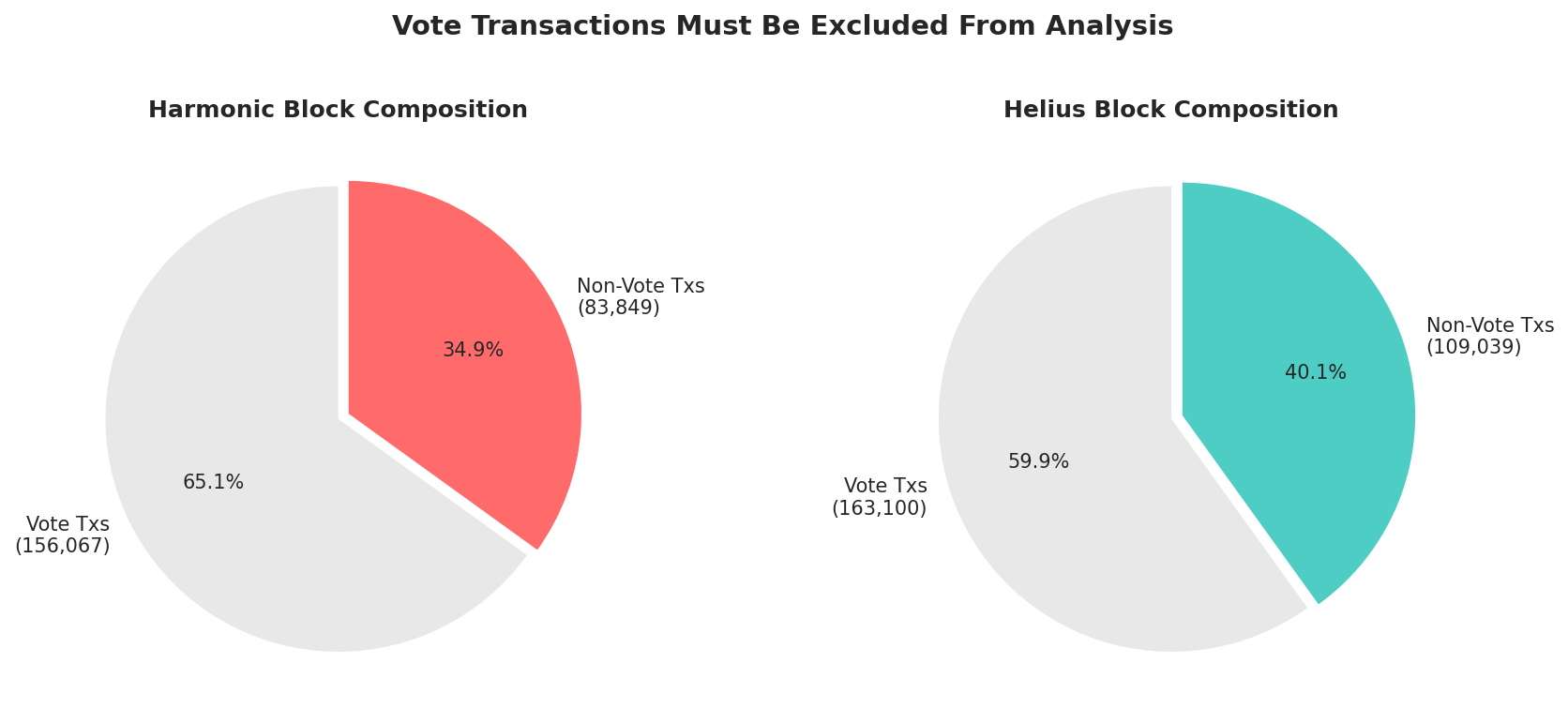
Without excluding vote transactions, our initial analysis showed Falcon at position ~0.78 in Harmonic blocks - seemingly “back-loaded.” But this was misleading. All non-vote transactions appear back-loaded when votes are included.
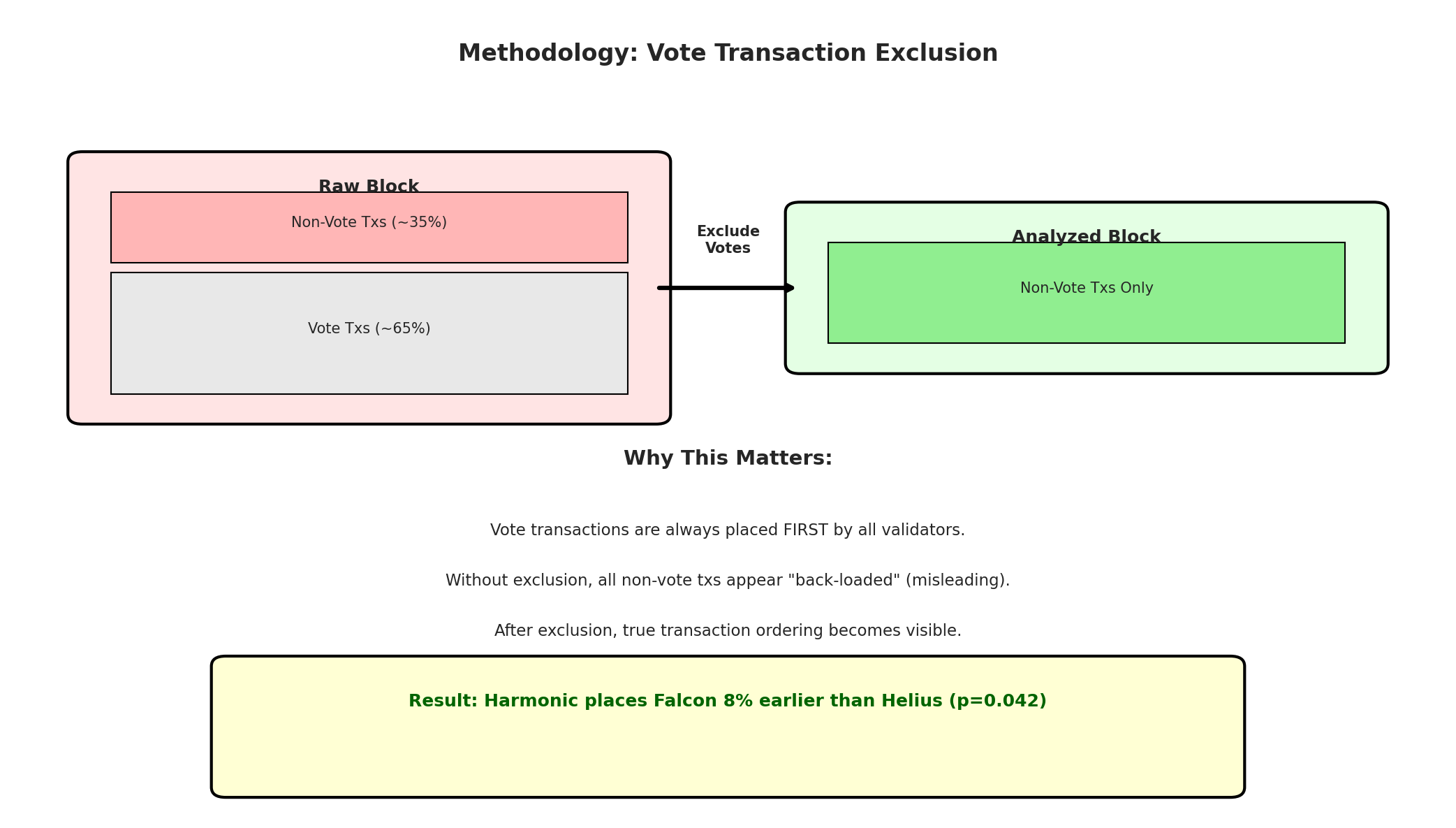
The fix: Exclude vote transactions and recalculate positions based on the non-vote transaction stream only.
Falcon Tip Accounts Tracked
We tracked transfers to these 10 Falcon tip accounts:
Fa1con11xLjPddfzRwRUB16sbFZggp2JeJkCeWREyR8X
Fa1con11TM1RuAQzbQzYjTy4Ekfap9Lnc9fnEbQYEd6Q
Fa1con113Bvi76nS5AzUiRDC2fqjfzkNMUNRLgQybMYt
Fa1con1QGHJK232s8yZpzZZwqPexnAKcoyKj626LNsMv
Fa1con1zUzb6qJVFz5tNkPq1Ahm8H1qKW7Q48252QbkQ
Fa1con16d3MSwd3SAiwvr2LwgkpE7ot8zntbpuec8HAx
Fa1con1i7mpa7Qc6epYJ6r4P9AbU77DFFz173r59Df1x
Fa1con18nWn8TdAGL7JX8PertfMUGVSc899NawokJ4Bq
Fa1con1GKusK2EqsfzrDzGPaYZSxQtFGzJiRMMU9Zm2g
Fa1con1RDwVwM9VrJ53CwVefD3VU9c58EMpDawV7fLMi
The Results
Position Analysis (Vote Transactions Excluded)
| Validator | Mean Position | Interpretation |
|---|---|---|
| Harmonic | 0.430 | Front-loaded (7% earlier than fair) |
| Helius | 0.509 | Fair/random (~0.5) |
| Fair Baseline | 0.500 | Expected if no preference |
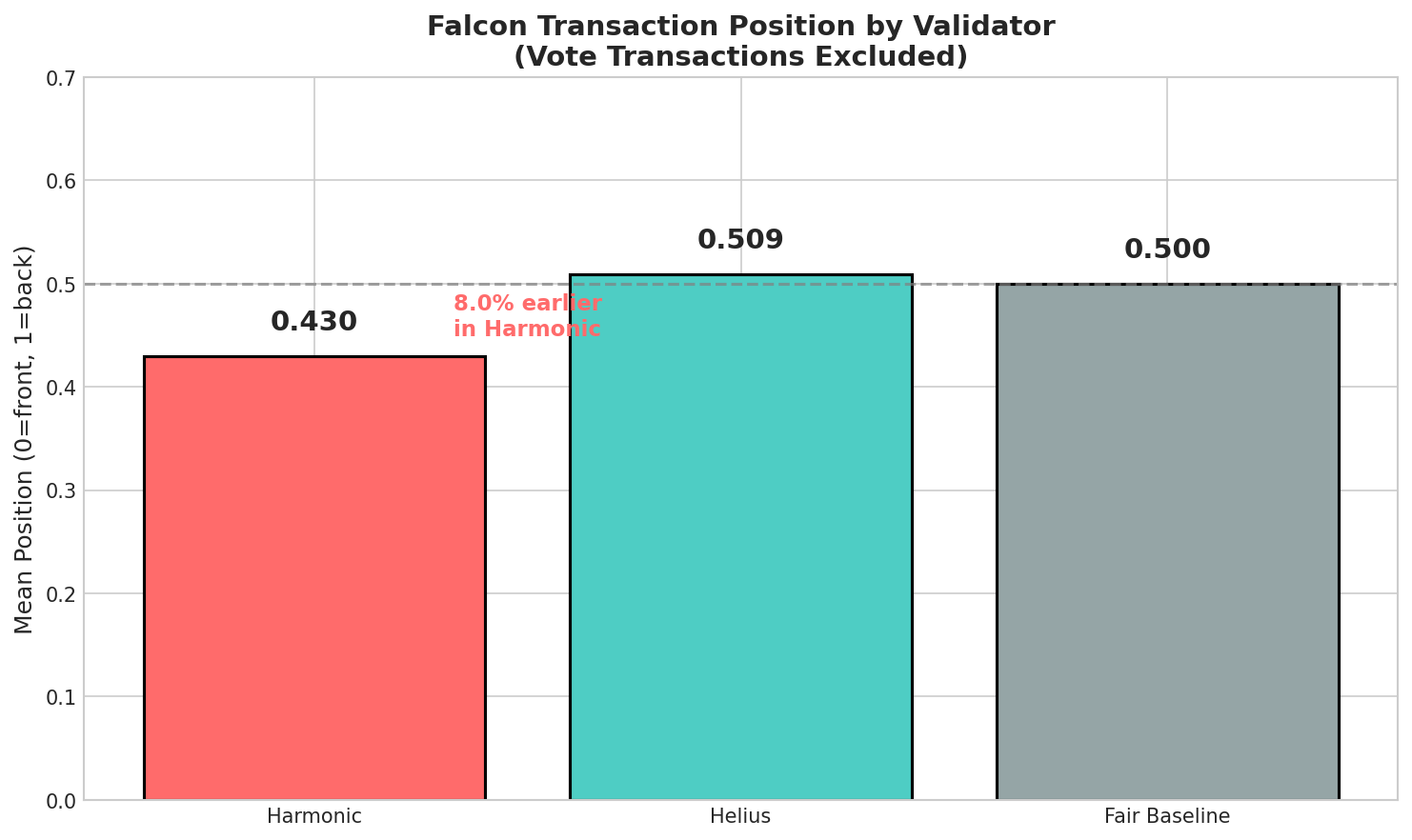
Statistical significance: p = 0.042 (significant at α = 0.05)
Falcon transactions appear 8% earlier in Harmonic blocks compared to Helius blocks. This is not random chance - it’s a statistically significant pattern.
Distribution Analysis
The histogram tells the full story:
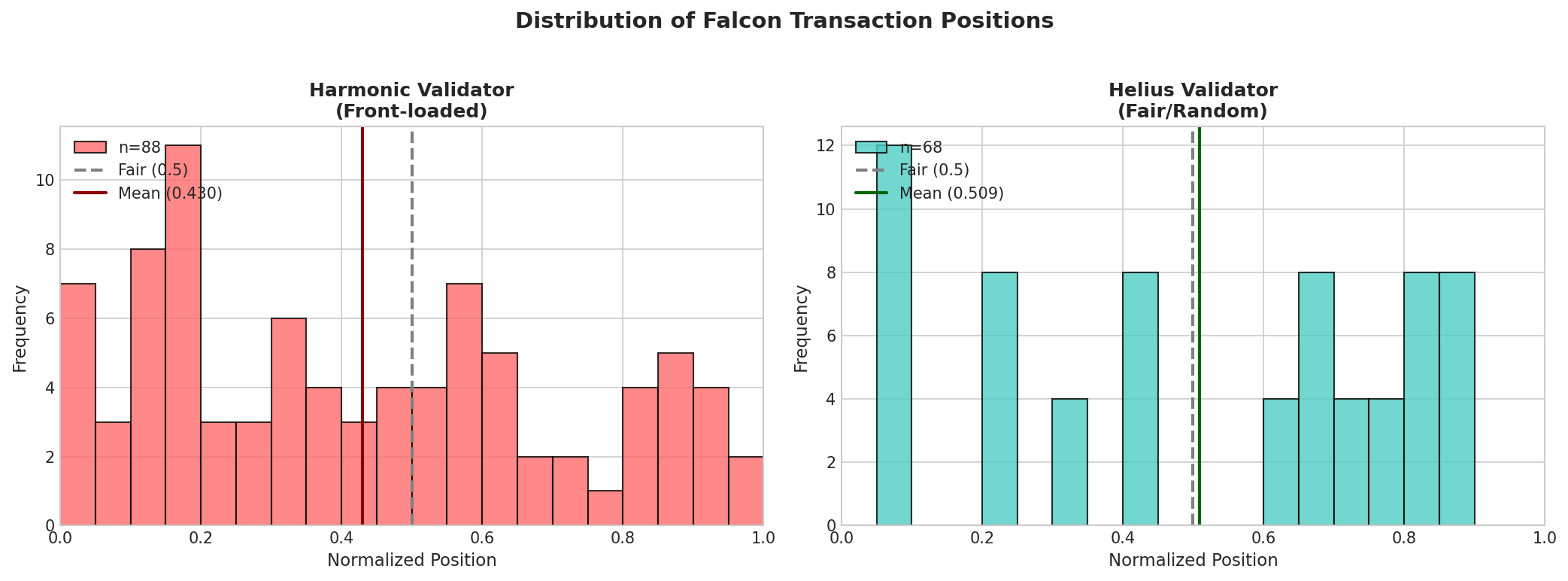
- Harmonic (left): Distribution skewed toward the front of blocks
- Helius (right): Distribution centered around 0.5 (fair)
Per-Block Consistency
This isn’t just a few outlier blocks. The pattern is consistent across individual blocks:
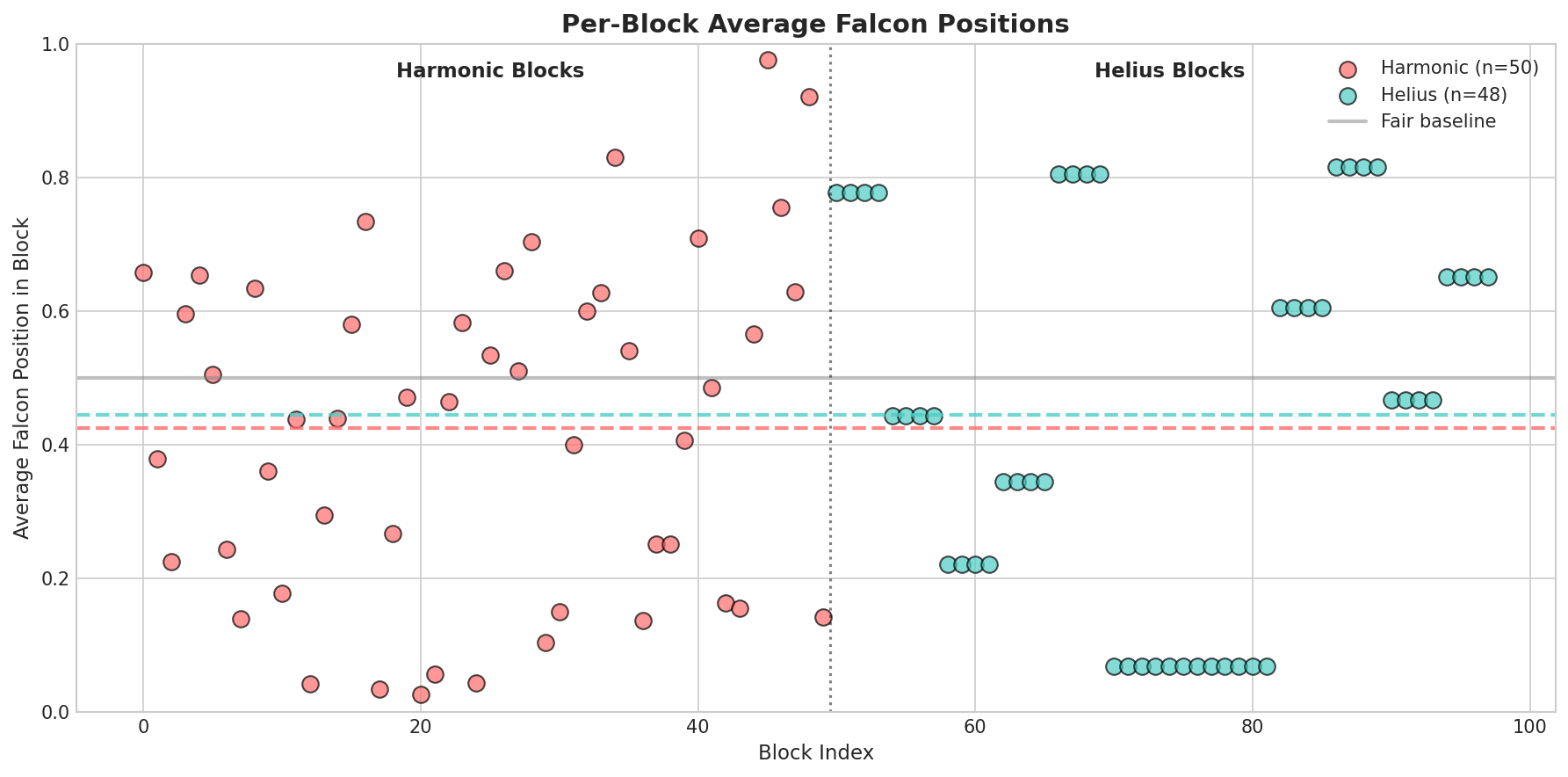
- 56% of Harmonic blocks have Falcon in the front half
- Helius shows the expected ~50% split
What About Inclusion Rates?
Interestingly, inclusion rates are identical between validators:
| Validator | Blocks with Falcon | Rate |
|---|---|---|
| Harmonic | 50/200 | 25.0% |
| Helius | 48/200 | 24.0% |
The arrangement is about positioning, not inclusion. Falcon gets into blocks at the same rate, but when they do, Harmonic places them earlier.
Transaction Volume Breakdown
After excluding vote transactions:
| Metric | Harmonic | Helius |
|---|---|---|
| Total Txs Analyzed | 83,849 | 109,039 |
| Avg per Block | 419 | 545 |
| Falcon Txs | 88 | 68 |
| Falcon % | 0.105% | 0.062% |
Why This Matters
An 8% position advantage might sound small, but in MEV:
- Arbitrage: Being 8% earlier means capturing price discrepancies before competitors
- Liquidations: First to liquidate gets the profit
- Sandwich attacks: Position determines profitability
- DEX trades: Earlier execution = better price impact
Over thousands of transactions, this compounds into significant profit.
The Bigger Picture
This research reveals what many suspected but couldn’t prove: validator-searcher arrangements exist on Solana. While Jito’s block space auction is transparent, off-protocol deals like this one operate in the shadows.
Implications for Other Traders
If you’re running MEV strategies:
- Know your validators: Different validators have different relationships
- TPU isn’t enough: Direct submission doesn’t guarantee fair ordering
- Consider the full picture: Inclusion rate isn’t the only metric that matters
Technical Details
Data Sources
- Block metadata: ClickHouse database (solana_blocks table)
- Transaction details: Helius RPC API
- Analysis period: 200 most recent blocks per validator
- Slot matching: Helius blocks matched to nearest Harmonic slot (avg 77 slot distance)
Statistical Methods
- Position test: Mann-Whitney U (one-sided, Harmonic < Helius)
- Inclusion test: Fisher’s exact test
- Vote exclusion: Filtered by Vote program ID (
Vote111111111111111111111111111111111111111)
Reproducibility
All code is available in our research repository:
uv run experiments/falcon_validator_priority/01_fetch_block_slots.py
uv run experiments/falcon_validator_priority/02_fetch_block_details.py
uv run experiments/falcon_validator_priority/03_analyze_positions.py
uv run experiments/falcon_validator_priority/04_inclusion_analysis.py
uv run experiments/falcon_validator_priority/05_generate_report.py
Conclusion
The data is clear: Falcon transactions receive priority positioning in Harmonic validator blocks. With a mean position of 0.430 vs 0.509 (p=0.042), Falcon is placed 8% earlier in Harmonic blocks compared to Helius.
This confirms what we experienced firsthand when our TPU submissions were consistently outpaced on Harmonic blocks. The MEV landscape on Solana includes private validator-searcher arrangements that give certain players an edge.
Key Findings:
- ✓ Falcon is front-loaded in Harmonic blocks (position 0.430 vs fair 0.500)
- ✓ 8% earlier than Helius blocks (statistically significant, p=0.042)
- ✗ No inclusion rate favoritism (both ~25%)
- ⚠️ Vote transaction exclusion is critical for accurate analysis
This research was conducted by Onchain Divers. The complete analysis code and data are available in our research repository. This is data-driven research, not accusations - we present the numbers and let them speak for themselves.